

China Fanfold Corrugated Cardboard: A Smart Choice for Flexible Packaging
2026-10-13
When packaging demands both resilience and flexibility, the usual options often fall short. Rigid boxes waste space, while flimsy alternatives compromise protection. Enter China fanfold corrugated cardboard—a continuous, z-fold sheet that bends where you need it and holds firm where it counts. From e-commerce shippers to automotive liners, this material adapts to odd shapes without sacrificing crush resistance. At ShiTeng Packaging, we see it as more than stock: it is a lean, just-in-time answer for businesses tired of pre-creased sheets that never quite fit. Curious how one board can change your packing line? Read on.
Fanfold Corrugated Cardboard Is Quietly Reshaping Flexible Packaging
Fanfold corrugated cardboard rarely gets the attention it deserves. Unlike rigid boxes that lock you into fixed dimensions, this continuous, accordion-folded sheet feeds directly into converting machines, letting operators cut exact lengths on the fly. That single shift removes the need to stock dozens of pre-made box sizes and frees up warehouse space that used to sit under stacks of empty cartons.
In flexible packaging lines, the material works as a shape-shifting buffer. It can be scored, folded, or wrapped around irregular products without the crinkle and snap of plastic films. Because it arrives flat and unfolds only when needed, it also cuts down on the constant restocking that plagues bubble wrap or foam peanut stations. Workers simply pull what they need, crease it by hand or machine, and move on.
The quiet part is that none of this feels revolutionary on the floor. There’s no new machinery to learn, no dramatic changeover. Yet the cumulative effect—less storage, fewer material types, faster packing—slowly rewires how a fulfillment area operates. Fanfold corrugated simply fits into gaps that rigid packaging never could, and that adaptability is what keeps it spreading through e-commerce and light industrial settings.
The Storage and Freight Advantage of Continuous Board
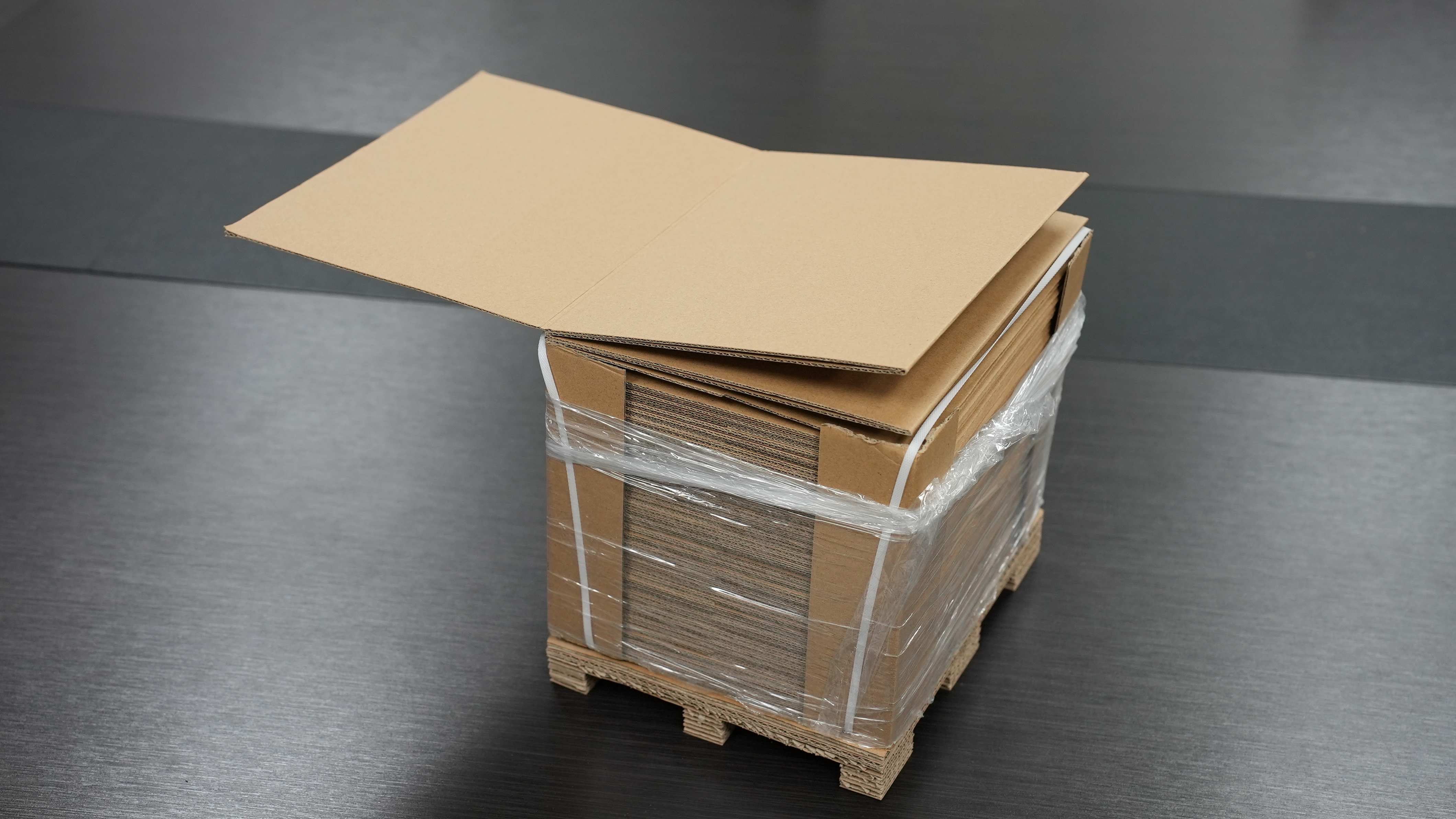
Continuous board changes the math on warehouse space before it ever reaches a job site. Because it comes off the line in longer, more uniform runs, distributors can stack it tighter and use vertical space that would otherwise be wasted on awkward offcuts. Standard racking layouts work without needing to leave gaps for irregular panel sizes, and that translates directly into lower cost per square foot stored.
Freight is where the advantage gets even sharper. Continuous board packs into containers and flatbeds with fewer voids, so a single shipment carries more usable material without exceeding weight limits. That means fewer trips, less handling damage from shifting, and predictable unloading times at the receiving dock. For regional buyers, the ability to order exact lengths also eliminates the need to trim to size after delivery, which reduces scrap and the labour tied up in disposal.
The freight benefit also shows up in less obvious places. A continuous board shipment tends to sit flatter and more stable during transit, which cuts down on edge damage and warping that often appears when shorter bundles shift. Receiving teams spend less time re-stacking and inspecting, and the material can move from truck to rack or directly to production with almost no re-handling. That quiet efficiency is exactly what turns a lower freight bill into a real margin gain.
Flute Profiles and Liners: Matching the Board to the Job
Choosing the right flute profile isn't just about thickness—it's about how the board will be handled, stacked, and printed. A fine A-flute offers excellent cushioning and stacking strength for heavy items, while a slimmer B-flute provides a flatter surface for high-quality graphics and die-cutting. The liner combination matters just as much: a kraft top liner holds up better in humid conditions, whereas a white top liner gives retail packaging a cleaner print finish without the need for an extra label.
For products that travel long distances or sit in cold storage, pairing a C-flute with a water-resistant liner can prevent corner crush and edge wick. Conversely, if the box needs to be folded frequently or assembled by hand, an E-flute micro-profile with a lightweight liner reduces hand fatigue and keeps the crease lines crisp. The trick is to match the flute height and liner grade to the actual abuse the package will face—not just the weight of the contents.
In practice, many converters run hybrid boards, like an EB-flute, to get both printing quality and stacking strength. The liner's caliper and fiber content also affect how well the board scores, glues, and resists moisture. Testing a sample under real load and humidity is still the fastest way to confirm that the chosen flute and liner will hold up from the production line to the customer's doorstep.
Custom Widths and Perforations That Keep Packing Lines Moving
Standard roll sizes often force operators to stop and swap materials mid-run. Custom widths eliminate that interruption by matching the exact dimensions of the product or container, so the film, paper, or wrap sits flush without excess overhang. The result is less waste and fewer pauses for adjustment.
Perforations can be positioned at intervals that match your packaging cycle. Instead of tearing by hand or using a separate cutter, workers pull against a pre-scored line and get a clean break every time. The rhythm stays consistent, which keeps the line from backing up while someone fumbles with scissors or a blade.
When widths and perforations are engineered together for a specific line, you don't need to force a generic material to behave. It already fits the machine's feed rate, sealing temperature, and take-up tension. That kind of integration is what actually keeps throughput steady over a full shift rather than just the first hour.
Moisture, Dust, and Edge Crush: Building In Durability
Real-world handling rarely sticks to ideal conditions. Corners get knocked, humidity climbs inside trailers, and fine dust finds its way into seams. A board that passes a lab test in dry, flat form can still fail after a few weeks on a warehouse floor. The trick is to design for the abuse that doesn't show up in a spec sheet.
Moisture weakens fiber bonds long before visible warping appears, so we lean on water-resistant liners and tighter flute profiles rather than relying on extra caliper alone. Edge crush strength gets attention at the score lines and die-cuts, where stress concentrates. Meanwhile, dust is treated as a slow abrasive—sealing exposed edges and choosing coatings that don't shed under vibration keeps both the product and the packaging machinery cleaner over time.
Evaluating Chinese Fanfold Suppliers Beyond the Data Sheet
A spec sheet tells you the dielectric constant and thermal conductivity, but it doesn't whisper how a supplier handles a last-minute change to fold spacing or whether they'll proactively flag a material lot that drifts out of tolerance. Real evaluation starts with a live line audit: watch how operators handle splice waste, ask to see the actual slitting blades in rotation rather than the showpiece set, and time the changeover between two different fold patterns. If the floor supervisor can't explain their process for controlling static buildup on a low-humidity day, that's a louder warning than any missing datasheet value.
Next, dig into their raw material sourcing habits. A fanfold supplier might list an impressive UL file number, but what happens when that particular film becomes scarce? Ask for a history of substitutions over the past two years and whether they re-qualify each new lot with a real adhesion test on your specific adhesive, not just a bench-top tape peel. The sharpest suppliers keep a small library of your actual laminate coupons from previous shipments and will run a quick comparative peel before shipping a new batch—without being asked.
Finally, test their documentation in a way no datasheet can capture. Request the lot traceability file for a shipped roll from six months ago, then ask them to walk you through every raw material lot, process parameter, and QC checkpoint in under ten minutes. If the file arrives as a clean PDF with handwritten margin notes that align with their verbal explanation, you're likely dealing with a supplier who treats fanfold production as a craft rather than a commodity. That's the difference a spreadsheet can't show.
FAQ
It's a continuous ribbon of corrugated board that's creased and folded back and forth into a compact stack. You simply pull out the length you need, cut or tear along the fold, and wrap or line a box—there's no need to pre-order dozens of fixed sheet sizes.
Fanfold gives you flexibility on the floor. Instead of stocking multiple box sizes, you keep one stack and cut panels to fit odd-shaped products, fill voids, or create protective layers. It reduces inventory clutter and handles last-minute packing changes without slowing things down.
The top Chinese mills use the same basis weights and flute profiles as Western counterparts, and many are certified for food-contact or export packaging. The main difference is usually price and lead time, not the physical performance of the board itself—assuming you vet the supplier properly.
You can typically get B, C, E, and double-wall combinations. Thinner flutes like E work well for folding and wrapping, while C and double-wall offer stronger cushioning for heavier items. Many suppliers will run custom flute combinations if your volume justifies it.
Yes, it's generally made from recycled paper and is fully recyclable after use. Because you cut only what you need, there's less offcut waste than with pre-cut sheets. Some Chinese suppliers also offer FSC-certified or high-recycled-content options if you require documentation.
It's widely used for wrapping furniture, glass panels, automotive parts, and e-commerce shipments with irregular shapes. You'll also see it as void fill, pallet interleaving, or protective corners in export crates.
Check the moisture content, burst strength, and edge crush test results rather than relying on visual thickness alone. Also confirm the fold spacing and stack height match your cutting or dispensing equipment, and ask for a pre-shipment sample to inspect flute bonding.
Yes, many Chinese manufacturers offer flexo or digital printing on the outer liner before corrugating. Keep in mind that continuous fanfold printing works best with repeating logos or patterns, and you'll need to coordinate the repeat length with the fold pitch to avoid misalignment.
Conclusion
Chinese fanfold corrugated cardboard earns its place as a smart choice for flexible packaging because it solves several operational problems at once. The continuous, zig-zag folded board removes the need for individual sheet handling, which means fewer interruptions during box forming or void filling. Freight and warehousing math pushes the advantage further: a single stack of fanfold occupies a small fraction of the space required by pre-erected cartons, so more usable board arrives per container and sits flat until needed. That compressed footprint lowers inbound logistics costs and frees up floor space—an often underestimated benefit that quietly reshapes how distribution centers plan packaging inventory.
The right flute profile and liner combination determine whether the board can handle light wraps or heavy industrial parts, and Chinese suppliers have become skilled at matching these variables to specific packing tasks. Custom widths and strategically placed perforations let the fanfold run through automated lines with minimal hand trimming, keeping throughput steady across shifts. Durability is engineered rather than assumed: moisture-resistant liners, dust-repellent coatings, and reinforced edge crush strength help the board survive humid warehouses, gritty loading docks, and stacked freight pressure. When evaluating a Chinese fanfold source, the spec sheet only tells part of the story. Real differentiation comes from checking batch-to-batch flute consistency, requesting samples from actual production runs, and verifying that edge crush test results align with the stated grade—details that separate dependable long-term partners from opportunistic vendors.
Contact Us
Contact Person: Mr. Ge Man
Email: [email protected]
Tel/WhatsApp: 8613710506492
Website: https://www.shitengzx.com