

Continuous Still Company Transforms Distilling with Unmatched Efficiency
2026-06-13
Distilling is undergoing a quiet revolution, and at its heart is the Continuous Still Company—pioneering a method that slashes energy use and redefines output. Imagine producing spirit at a pace that leaves traditional pot stills in the dust, all while preserving the depth of flavor that connoisseurs demand. For an industry hungry for both scale and soul, this shift feels overdue. We’ve been watching this space closely at DYE, and the numbers are startling: lower costs, less waste, and a consistency that even the most seasoned distillers are calling a game-changer. So what makes continuous distillation more than just a buzzword? Let's unpack the machinery, the mindset, and the mastery that’s turning heads—and stills—across the craft.
Redefining Speed: How Continuous Stills Outpace Traditional Methods
Batch distillation has long been the workhorse of spirit production, but it comes with inherent downtime—emptying, cleaning, and refilling between runs. Continuous stills flip this model entirely. Instead of stop-start cycles, they maintain a constant flow of feedstock, stripping, and rectification, effectively producing around the clock. This steady-state operation slashes idle time, translating directly into higher throughput. A well-designed continuous column can double or even triple the output of a comparably sized batch setup over the same period, redefining what "fast" means in a distillery.
The secret lies in the physics of mass transfer. In a continuous column, fermented wash enters near the top while steam rises from the bottom, creating a perpetual gradient of temperature and alcohol concentration. Volatiles separate not in discrete batches but in a smooth, uninterrupted cascade. Plates or packing material provide immense surface area for vapor-liquid contact, allowing ethanol to be drawn off at precise points in the column. This efficient use of energy and space means that a continuous still can reach desired purity and flavor profiles in minutes, whereas batch pots might need hours for a single distillation.
Beyond raw speed, continuous distillation delivers remarkable consistency. Because the process never stops, operators can fine-tune parameters—feed rate, steam pressure, reflux ratio—and lock in a profile that repeats exactly, hour after hour. Subtle variations that plague batch runs are smoothed out. This doesn't mean sacrificing character; modern continuous stills often include multiple draw points and integrated doubler systems, allowing distillers to capture distinctive fractions that rival artisan batch spirits. The result is a union of speed and precision that traditional pot stills simply cannot match.
The Science Behind Uninterrupted Distillation
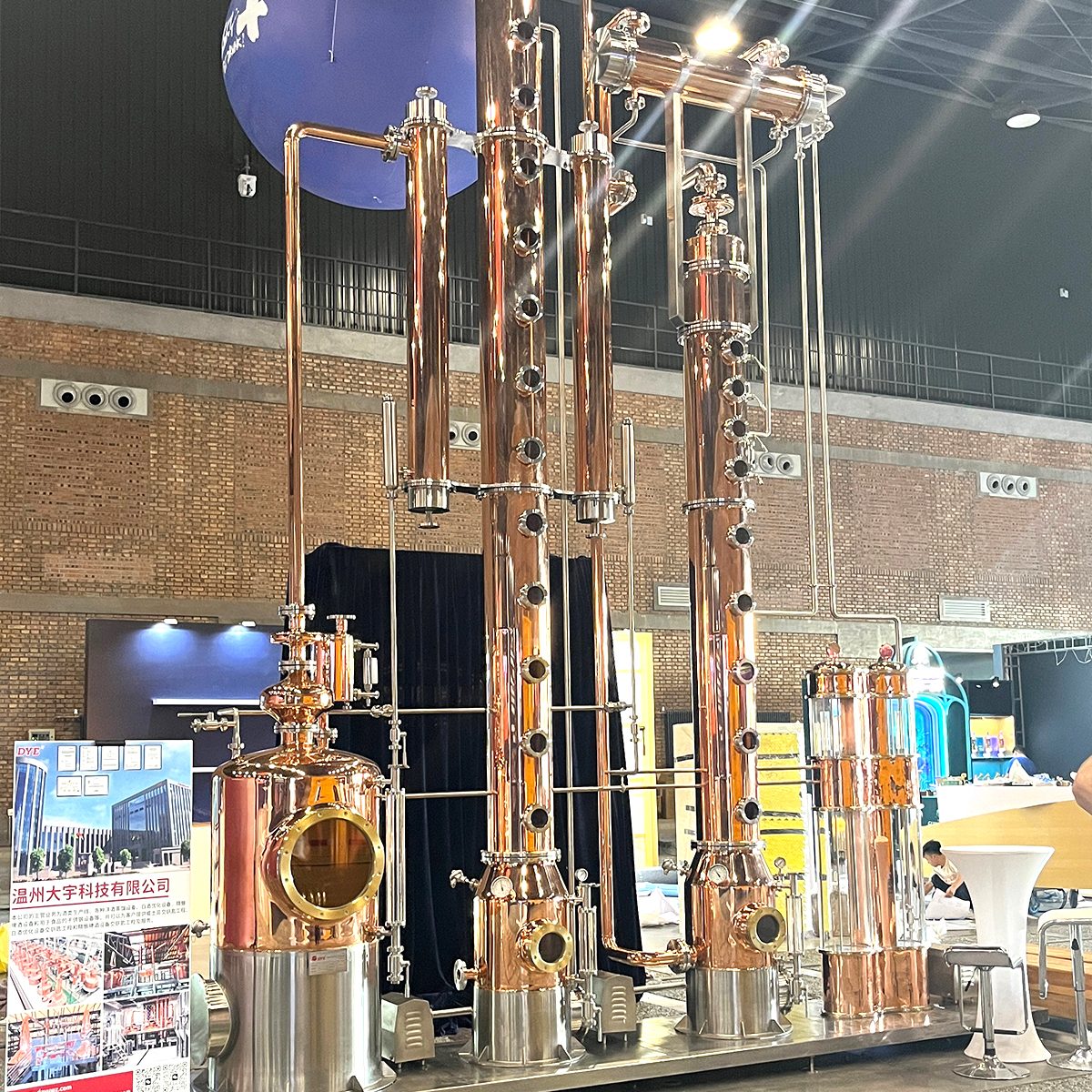
Distillation works because different compounds have different boiling points. When a mixture is heated, the more volatile components turn into vapor first. This vapor is then cooled and condensed back into liquid, collected separately from the original blend. In an uninterrupted setup, this process runs continuously without stopping, which requires precise control of heat, cooling, and flow rates. The core science lies in phase equilibrium and mass transfer—how molecules move between liquid and vapor phases. To keep it steady, industrial systems rely on columns packed with structured materials that increase surface area, allowing repeated vapor–liquid contact, which sharpens the separation at every level.
The real challenge is maintaining the balance when feed composition shifts or ambient conditions change. Uninterrupted distillation leans on real-time sensors and feedback loops that adjust reflux ratios and energy input automatically. Inside the column, temperature gradients form stable zones where specific components concentrate. This isn’t just about holding a set point; it’s about dynamically responding so the bottom product and overhead distillate remain consistent. The science borrows from thermodynamics and transport phenomena—the same principles that govern how a kettle boils, but scaled and tuned to industrial precision. Small fluctuations in pressure or rate can tip the balance, making robust control algorithms essential for quality output over hours or days.
One overlooked factor is fluid dynamics inside the column. Vapor rises at a certain velocity, and if it’s too fast, liquid floods the packing; too slow, and separation efficiency drops. Engineers model these regimes using things like Fenske’s equation or McCabe-Thiele diagrams to find the sweet spot for continuous runs. Uninterrupted operation also depends on how well the system handles startup and shutdown sequences without thermal shock, which stresses materials and can crack seals. Modern designs use simulation-driven insights to pre-empt bottlenecks, ensuring that what starts as a lab-scale theory translates into a resilient, always-on separation machine.
Quality Without Compromise: Consistent Output at Scale
Scaling production often introduces trade-offs that quietly erode quality. Many teams accept minor defects or slower response times as inevitable when demand surges, but that mindset is a trap. The real challenge isn't just keeping up with volume—it's doing so while preserving every detail that defines excellence. From manufacturing tolerances to customer support interactions, consistency must be engineered into the system rather than left to chance.
Achieving this demands more than surface-level automation. It requires processes and tooling designed to catch drift before it becomes visible to the end user. For instance, real-time monitoring paired with statistical process control can flag subtle deviations far earlier than manual checks. Equally important is culture: teams that treat every unit shipped or every query answered as a direct reflection of their reputation naturally uphold higher standards. When quality gates are non-negotiable and feedback loops are short, consistency becomes a byproduct of the workflow itself.
The payoff goes beyond reducing complaints. Customers develop a subconscious trust when every interaction feels predictably refined, whether it's their first purchase or their hundredth. This reliability becomes a competitive moat that no marketing budget can replicate. In the long run, organizations that refuse to let quality waver under pressure don't just satisfy demand—they shape it, because their output itself sets the benchmark others struggle to match.
From Craft to Large-Scale: A Versatile Solution for Distillers
Distillers often face a tough challenge when moving from small artisan batches to full commercial production. Equipment designed for craft-scale operations rarely adapts well to increased volume, forcing expensive retooling or complete replacement. This practical solution bridges that gap by allowing the same core system to scale smoothly—what starts as a hands-on setup for experimental runs can grow into a high-output configuration without sacrificing the nuances of the spirit.
The heart of this approach lies in a modular design that integrates build-as-you-go flexibility. Operators can start with a compact unit tailored to recipe development and limited releases, then add modules to ramp up capacity when demand rises. Consistent vapor paths, interchangeable components, and straightforward process control ensure that the character of the distillate remains true, whether producing a few hundred liters or several thousand. It’s simply a smarter way for distillers to expand their craft on their own terms.
Energy Savings That Reshape the Bottom Line
Cutting energy costs isn’t just an operational tweak—it’s one of the fastest ways to free up capital that can be redirected into growth. When a business trims its power consumption, the savings ripple straight to the bottom line, improving margins without requiring a single additional sale. That’s real, tangible profit from simply running smarter.
The path to meaningful savings often starts with retrofits that pay for themselves in months, not years. Upgrading to efficient lighting, optimizing HVAC schedules, or fixing compressed air leaks can slash usage by double digits. It’s low-hanging fruit that many overlook, yet the financial return is both immediate and compounding.
Beyond the obvious utility bill reductions, disciplined energy management shifts how organizations think about resource allocation. Teams become more cost-aware, maintenance cycles improve, and unexpected downtime due to equipment strain becomes less frequent. Over time, these ancillary gains build a leaner, more resilient operation that keeps delivering year after year.
Ushering in a New Era for Spirits Production
Distilleries are shedding their traditional cloaks and stepping into a future where precision meets passion. Advanced monitoring systems now track fermentation in real time, allowing master blenders to fine-tune flavor profiles with an almost intuitive grace. It’s no longer just about following ancestral recipes; it’s about understanding the chemistry at a granular level and using that knowledge to push boundaries without losing the soul of the spirit.
Sustainability has also moved from a buzzword to a core principle reshaping production lines. From heat recovery systems that slash energy consumption to closed-loop water processes, the modern distillery operates with a lighter footprint. Old copper stills sit comfortably beside solar-powered heating elements, proving that heritage and innovation can coexist beautifully.
The real magic, though, happens in the storytelling. Small-batch releases celebrate hyper-local ingredients, while transparent labeling invites drinkers into the journey from grain to glass. This isn’t just manufacturing; it’s a dialogue between maker and consumer, where each bottle carries a narrative of place and process. As the industry evolves, it’s clear that the new era values artistry over assembly lines, creating spirits that resonate long after the last sip.
FAQ
They focus on designing advanced continuous distillation systems for spirits producers.
Instead of batch processing, their continuous stills run non-stop, dramatically cutting production time and energy use.
Many report up to 40% less energy consumption and a significant increase in output without sacrificing quality.
Yes, from whiskey and rum to vodka and gin, the technology is adaptable to a wide range of recipes and flavor profiles.
Not at all; the precision control allows distillers to fine-tune the process and maintain the intended character of the spirit.
Feedback has been overwhelmingly positive, with several craft and large-scale distilleries already adopting the technology full-time.
They’re expanding into new markets and continuously refining their systems to push the boundaries of what’s possible in distillation.
Conclusion
By eliminating the need for batch cycles, the Continuous Still Company has redefined production speed, enabling distilleries to operate around the clock with a steady stream of high-purity spirit. This uninterrupted process relies on advanced thermal dynamics and automated separation, ensuring that each drop matches the last in character and strength—a sharp departure from the variability often seen in traditional pot still distillation. The result is a platform that accommodates everything from small-batch craft recipes to high-volume commodity spirits, all while maintaining an artisan’s attention to detail without the typical labor or time penalties.
Beyond throughput and consistency, the real revolution lies in resource efficiency. These continuous systems slash energy consumption and waste by recapturing heat and minimizing water usage, reshaping operational costs and environmental impact simultaneously. For an industry balancing heritage with modern demands, the Continuous Still Company delivers a bridge from time-honored distilling methods to a scalable, sustainable future—ushering in a new era where efficiency never comes at the expense of quality.
Contact Us
Contact Person: Ada Xu
Email: [email protected]
Tel/WhatsApp: 0577-86806088
Website: https://www.dayuwz.com/