

Custom Aluminum Tray Factory Insights: Crafting Precision Solutions for Diverse Industries
2026-07-03
Behind every seamless industrial process lies a component often taken for granted—the custom aluminum tray. From electronics to aerospace, these precision-engineered solutions quietly power efficiency and reliability. At APEXAL, we don't just manufacture trays; we craft tailored answers to complex challenges, blending material expertise with innovative design. Join us as we peel back the layers of this essential yet overlooked world, revealing how custom aluminum trays are shaping the future of diverse sectors.
Precision Beyond Standard: Tailoring Aluminum Trays to Your Exact Needs
When off-the-shelf aluminum trays can’t meet the unique requirements of your project, customization steps in to bridge the gap. It’s not just about dimensions—though those matter—it’s about shaping a solution that matches your production flow, material handling, or presentation demands exactly. From bespoke thickness that balances weight and durability to specialized edge profiles that reduce snagging during automated processes, every detail is crafted to function as an integral part of your operations rather than a generic afterthought.
Material choice goes deeper than standard grades. Depending on the environment, you might need a specific alloy for enhanced corrosion resistance in harsh washdowns, or a temper that allows for repeated forming without cracking. Surface finishes, too, can be engineered: a textured finish to hide fingerprints in consumer-facing applications, a non-stick coating for easy release, or an anodized layer that adds both hardness and color-coding options. These aren’t typical catalog items—they’re deliberate decisions made with your use case in mind.
The real advantage surfaces in how these trays integrate with your existing systems. Imagine a tray with precisely stamped locator pins that align with your conveyor’s registration marks, or venting patterns calculated to speed up cooling without compromising structural integrity. Even the way the tray nests with others during storage can be optimized to save space and reduce transport damage. It’s this level of thoughtful engineering that turns a simple container into a seamless component of your workflow.
Material Matters: Why Aluminum Is the Backbone of Durable, Lightweight Trays
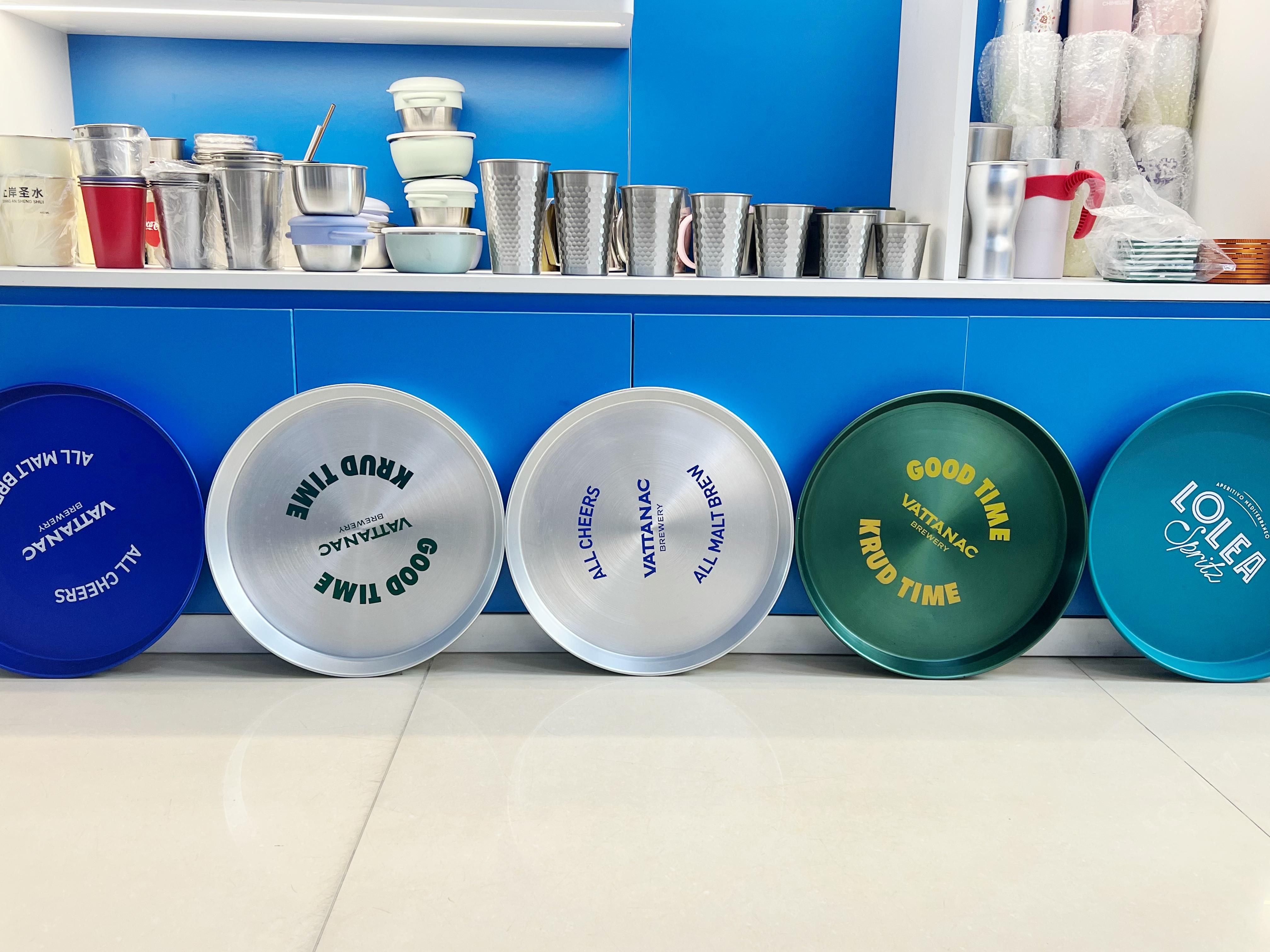
Aluminum has quietly become the unsung hero of modern tray design, and for good reason. Its natural ability to resist corrosion means these trays laugh in the face of moisture, acids, and the daily grind that would leave lesser materials pitted and stained. Unlike steel, aluminum won't rust when exposed to water or humidity—making it a go-to for kitchens, labs, and outdoor settings where durability is non-negotiable. That innate toughness doesn't add bulk, either; it simply stays reliable, year after year, without a protective coating that might chip or peel.
What truly sets aluminum apart is how it marries strength with featherlight agility. Picking up an aluminum tray feels almost startling—you expect heft, but get something you can maneuver with one hand. Yet it won't flex or bend under a heavy load of dishes, tools, or equipment. This unusual pairing comes from the metal's high strength-to-weight ratio, which makes it a favorite in industries where every ounce counts without sacrificing dependability. Imagine a catering team hauling stacked trays up a flight of stairs, or a camper packing gear into tight spaces—aluminum makes these tasks feel effortless.
Beyond the practical perks, there's a subtle elegance to aluminum that engineers and designers keep coming back to. The material easily takes on various finishes—brushed, anodized, or even colored—allowing trays to blend into a sleek modern kitchen or a sterile medical environment with equal ease. It doesn't just perform well; it looks the part while doing it. And because aluminum conducts heat evenly, it pulls double duty in food prep: you can go from oven to table without switching vessels. That kind of versatility, combined with its long life and minimal care, makes the case clear—when a tray needs to be tough, light, and long-lasting, aluminum isn't just one option; it's the backbone of the whole idea.
Industry-Specific Solutions: From Medical Devices to Automotive Assembly
Customization lies at the heart of what we do. In medical device manufacturing, precision and cleanliness aren't just goals — they're non-negotiable. Our solutions slot directly into sterile production environments, handling delicate components with micron-level accuracy while meeting ISO cleanroom standards. Every clamp, feeder, and vision system is tailored to work with materials ranging from titanium bone screws to polymer-based surgical tools, ensuring zero contamination risk.
Switch to automotive assembly, and the rhythm changes entirely. Here, the demand is for brute reliability and blistering pace. Our systems thrive on high-mix production lines, swapping between battery modules, sensor housings, and mechanical linkages without missing a beat. We've engineered modular end-of-arm tooling that auto-adjusts to varied part geometries, cutting changeover times by up to 70%. Dust, vibration, and thermal swings? The hardware laughs them off.
The common thread is how we treat each project as a blank slate. Whether it's a traceability challenge in pharma packaging or a defect-detection puzzle in fuel system welding, we build from the ground up — no cookie-cutter modules, just purpose-fit engineering that slots cleanly into existing workflows. That's why a single automation platform can handle a pacemaker one minute and a door latch the next, with the same quiet competence.
Inside the Factory: Advanced Techniques That Shape Superior Trays
Stepping onto the production floor, the rhythmic hiss of injection molding machines fills the air. Here, molten polymer is forced into precision-engineered molds at pressures that would crush lesser equipment. It’s not just about speed—the real magic lies in the proprietary cooling channels snaking through the tooling. These aren't your standard straight-line bores; they’re contoured to mirror the tray’s geometry, pulling heat out uniformly and preventing the warping that plagues rushed jobs. The result is a tray that emerges from its metal cocoon with a glass-flat base and crisp, repeatable edges, cycle after cycle, without the brittleness that often comes from forced cooling.
A few steps away, the thermoforming line tells a different story of ingenuity. Instead of starting from liquid resin, massive sheets of extruded plastic are clamped and heated until they sag into a pliable state. What happens next separates this process from the hobby-grade setups: a vacuum pulls the sheet into a water-cooled aluminum tool while a plug assist simultaneously drives it from above, ensuring consistent material distribution even in the deepest corners. The trays pick up subtle, functional details—a gentle radius here, a stiffening rib there—that emerge not from post-processing but from the sheer physics of the forming process. Watching the automated trimming station kiss the tray with a laser, you realize each edge is cut with a tolerance thinner than a human hair, leaving nothing to chance.
Beyond the machinery, it’s the invisible quality gates that truly elevate the output. In a quiet corner of the plant, trays cycle through a monochromatic light tunnel where camera arrays hunt for surface defects that the naked eye would never catch. Simultaneously, a coordinate-measuring machine sporadically plucks samples from the line, mapping them against a digital twin to verify that every draft angle and wall thickness falls within spec. Even the material itself is under constant surveillance—an inline viscometer checks the melt’s flow characteristics, adjusting heater bands on the fly to compensate for any batch variation. It’s this relentless, layered scrutiny, baked directly into the workflow rather than tacked on at the end, that turns a simple piece of packaging into a supremely consistent engineering component.
Design Freedom: Unlocking Complex Geometries with Expert Engineering
Designers have long been constrained by the limitations of traditional manufacturing processes, where intricate shapes were either impossible or prohibitively expensive to produce. Today, advances in computational design and additive manufacturing have shattered these barriers, enabling the creation of forms that were once relegated to the realm of imagination. From organic, nature-inspired structures to highly optimized lattice geometries, the fusion of creative vision with sophisticated engineering tools opens up an entirely new language of form and function.
However, achieving true design freedom isn’t simply about having the right software or machinery—it requires a deep understanding of material behavior, structural integrity, and production feasibility. Expert engineers bridge the gap between digital models and physical reality, fine-tuning parameters so that a complex geometry not only looks stunning but also performs reliably under real-world conditions. They navigate challenges like stress concentrations, thermal dynamics, and support structures, ensuring that what is conceived on the screen can be built to exacting standards.
Ultimately, this synergy between unbridled creativity and meticulous engineering unlocks possibilities across industries, from lightweight aerospace components to custom medical implants and avant-garde architectural elements. By pushing the boundaries of shape complexity while maintaining rigorous performance criteria, teams can deliver solutions that are as functional as they are visually captivating—proving that in the right hands, the most challenging geometries become an advantage rather than an obstacle.
Quality Without Compromise: The Rigorous Checks Behind Every Tray
From the moment raw materials arrive at our facility, a chain of uncompromising inspections begins. Each sheet of metal, every batch of coating, is tested for purity, strength, and consistency before it ever touches a production line. We don't just trust supplier certs—our own lab runs spectrographic analysis and stress tests to confirm every spec. If a single parameter drifts, the entire lot is rejected. That's the first of many gates a tray must pass.
On the floor, things get more granular. Every tray is measured at multiple stages—thickness, edge curvature, surface finish—under calibrated digital gauges that log data in real time. A tray that's off by a fraction of a millimeter is yanked and forensically reviewed. But measurements alone aren't enough. We also simulate real-world abuse: trays are loaded past rated capacity, exposed to temperature swings, and run through abrasive cycles to check coating adhesion and anti-slip performance. The goal isn't just to catch defects; it's to understand why they almost happened and eliminate that gap permanently.
The final audit happens with human eyes and fingertips. Our finishing team inspects each tray under angled light for micro-scratches, runs a hand over edges to ensure no burr escapes, and verifies every logo placement. Packaging gets the same scrutiny—trays are wrapped, boxed, and then drop-tested to guarantee they arrive as pristine as they left. No matter how tight deadlines get, no tray ships without passing every one of these checkpoints. That's how we define quality without compromise.
FAQ
We start by understanding the exact application, whether it's for electronics, medical devices, or aerospace. Our engineers collaborate with clients to define dimensions, tolerances, surface finishes, and any special features like stacking lugs or anti-slip coatings. The goal is a tray that fits seamlessly into their assembly or handling process.
We use automated CNC machining and proprietary holding fixtures to maintain consistency. Regular inspections with CMM and laser scanning verify that every tray meets the specified tolerances. Our process controls and real-time monitoring catch any deviation early, so quality stays locked in from first part to last.
5052 and 6061 are popular for their strength-to-weight ratio and corrosion resistance. For food or medical applications, we often use 3003 or 1100 because they're easy to sanitize and work-harden slowly. We advise on the best grade based on the environment, load, and regulatory requirements.
Absolutely—deep draws, embossed cavities, pierced holes, and folded edges are all within our wheelhouse. Our tooling capabilities let us form intricate geometries that hold parts securely or guide automated pick-and-place systems. If you can sketch it, we can usually manufacture it.
We have flexible tooling approaches, like modular dies and soft tooling, that make low quantities cost-effective. Prototypes can be ready in a matter of weeks, allowing you to test fit and function before committing to full production. We treat each prototype with the same attention to detail as a large order.
We offer anodizing (clear or colored), powder coating, chem-film, and laser marking. Anodizing adds durability and scratch resistance, while powder coating provides a wide color range for branding or part identification. For cleanroom use, we can apply a smooth, non-particle-generating finish.
Our facility is certified to ISO 9001 and 13485 for medical devices, and we’re familiar with aerospace NADCAP and automotive IATF 16949 standards. We provide full material traceability, certificates of conformance, and can manage PPAP or FAI documentation as needed.
Typical lead times range from 4 to 8 weeks, depending on complexity and tooling availability. We prioritize clear communication throughout—you’ll get a realistic timeline during the quoting stage and regular updates as the order moves through production, so there are no surprises.
Conclusion
Custom aluminum tray manufacturing transcends off-the-shelf limitations, offering solutions that align precisely with operational demands. Unlike generic alternatives, these tailored trays integrate seamlessly into workflows, whether for delicate medical instruments or robust automotive components. Aluminum’s intrinsic properties—lightweight yet remarkably durable—make it an ideal foundation. Its corrosion resistance and thermal conductivity further enhance performance in demanding environments. The factory’s expertise lies in translating unique specifications into functional designs, ensuring every contour and cavity serves a purpose. This level of customization not only improves efficiency but also reduces waste, as each tray is engineered to hold specific items securely during transport, storage, or assembly.
Behind the scenes, advanced manufacturing techniques like CNC machining, laser cutting, and robotic welding enable the creation of intricate geometries that standard production cannot achieve. Design freedom is paramount; engineers collaborate closely with clients to model complex shapes, incorporating features like nesting capabilities or integrated handles. Throughout production, rigorous quality checks—from material inspection to final fitment tests—guarantee that each tray meets exacting standards. These processes ensure longevity and reliability across diverse sectors, from aerospace cleanrooms to food processing lines. Ultimately, investing in custom aluminum trays means partnering with a factory that views precision not as a feature, but as the very core of its craft.
Contact Us
Contact Person: Milo
Email: [email protected]
Tel/WhatsApp: +86 18621923991
Website: https://www.dgbaide.com