

Flour Processing Machinery Plant Key Considerations for Modern Milling Operations
2026-10-01
Setting up a flour processing plant today is far from a turnkey affair. From fluctuating grain quality to energy costs that eat into margins, every decision—from sifter selection to pneumatic conveying—shapes your bottom line. Yet many operators still rely on outdated layouts. What if your milling operation could be streamlined from day one? At PINGLE, we've seen how the right machinery transforms bottlenecks into throughput. This post unpacks the key considerations modern mills can't afford to ignore.
Rethinking Mill Layout Around Material Flow, Not Machinery Placement
Many mills still arrange equipment the way a catalog page does: rows of machines grouped by function, each with its own floor slab and service clearance. The result looks orderly on a plan, but the actual product spends most of its time waiting or doubling back. When layout starts from the path material must take—rather than from where a particular machine fits—the distance between steps shrinks, and so does the need for temporary storage. A conveyor that used to loop around a support column can become a straight gravity chute if the screen is moved ten feet closer to the bin. That ten feet matters more than most equipment specs.
Focusing on material flow also changes how you think about bottlenecks and buffer zones. Instead of giving every machine the same generous aisle width, you widen the paths where material actually moves and tighten the areas that are only accessed for monthly maintenance. One plant cut its internal transport time by placing the packer directly below the sifter outlet, eliminating a bucket elevator and a horizontal screw conveyor that had been added simply because the machines had been placed on the same floor without regard for actual transfer distance. The new layout doesn't look as balanced on paper—it has a dense cluster at one end and open space at the other—but the material moves in one direction, without crossing its own path.
There is also a human factor: operators stop walking back and forth to check a gauge or clear a jam when the process follows a single visible line. Raw material enters at the north door, moves through crushing, grinding, classifying, and bagging in a gentle curve, and leaves through the south bay. Forklifts have a clean loop instead of threading between machines. It may feel unnatural to give material the prime floor space and fit the machinery around that constraint, but once you do, most layout debates about which machine goes where become much simpler.
Roller Mill Settings That Respond to Kernel Hardness Shifts
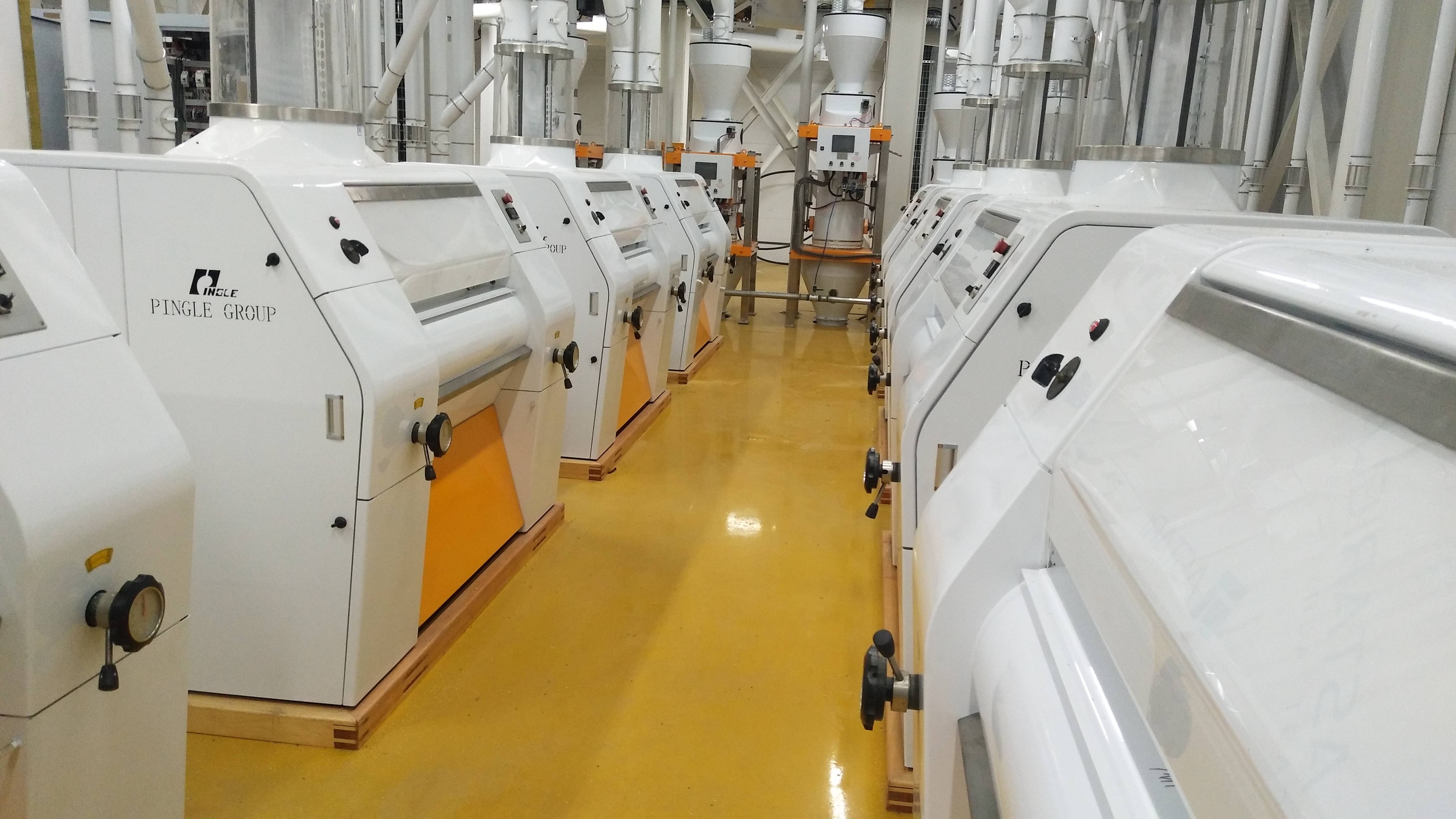
Milling wheat with consistent extraction starts by accepting that kernel hardness is not a fixed trait. A single load can shift from hard to soft within hours if storage moisture changes, or if blending pulls in a softer variety. Rather than locking roll gaps to a nominal setting, mills can pair online near-infrared hardness readings with a simple correction logic: tighter gaps for softer kernels to keep endosperm release high, and slightly wider gaps for harder kernels to prevent flake formation and motor overload.
The most responsive systems don't chase every minor fluctuation. They use a rolling average of hardness over fifteen to thirty minutes, then adjust first-break and second-break rolls by no more than 0.05 mm per step. This damping avoids overcorrection while still protecting sifter loading. For mills without automated actuators, a daily hardness check at the wheat intake can guide two or three preset roll positions, shifting the mill's baseline before visible changes in flour granulation occur.
Energy Use Patterns Most Plants Ignore Until Costs Climb
Most energy audits chase the big motors and furnaces, but the real drain often hides in patterns nobody bothers to question. Take compressed air: many plants keep the entire system pressurized through weekends and third shifts even when no tools are running. Small leaks and pressure drops force the compressor to cycle on every hour or so, burning power just to hold idle pressure. That short-cycling not only wastes electricity, it also shortens the life of seals and valves.
Another overlooked pattern is simultaneous heating and cooling. In older facilities, a process chiller and a boiler can run at full load at the same time because the control loops were never recalibrated after a layout change. Operators may manually tweak a valve here or there, but the underlying conflict quietly doubles energy use for months. Low power factor or voltage imbalance is similar: meters look steady, yet line losses and demand charges climb without any obvious equipment failure.
The sneakiest culprit is often the accumulation of idle loads. Conveyors, exhaust fans, task lighting, and battery chargers stay energized during breaks or between shifts. Each device might draw only 30 or 50 watts, but spread across a few hundred units, that becomes a permanent background cost. By the time someone notices an unusually high bill, the pattern has already hardened into routine and takes real effort to reverse.
Automation That Fits Your Workforce Instead of Forcing Retraining
Most automation platforms demand that your team learn an entirely new way of working before any value shows up. This approach quietly ignores the years of domain knowledge already sitting in your organization. Instead, the right tools observe how your people actually get things done—their existing shortcuts, naming habits, approval patterns—and wrap automation around those routines. The result is not a grand retraining program, but a gradual shift where the software does more of the repetitive lifting while your staff keeps using the mental models they already trust.
That fit matters more than raw capability. When a system expects everyone to abandon familiar interfaces for a generic dashboard, adoption stalls and workarounds multiply. A better design treats current workflows as the foundation, not the obstacle. It layers assistance into the tools your workforce already opens every day, meaning the first automated step can arrive within a week rather than after a quarter of classroom sessions. This preserves continuity and reduces the anxiety that typically accompanies digital change.
Over time, this approach builds confidence organically. Employees see the automated parts as helpful colleagues rather than replacements, because the system speaks their language and respects their judgment. Leaders gain visibility without forcing a top-down behavior overhaul. The outcome is a lighter implementation burden and a workforce that pulls automation forward instead of resisting it.
Dust Collection Designed for Real-World Leak Points
Most dust collection specs look great on paper until you walk around the actual unit after a few weeks of operation. The filter housing might be tight, but the real leaks show up at the seams nobody thinks about: the flanged connection between the hopper and the rotary valve, the access door gasket that gets compressed unevenly, the flex joint at the blower inlet. These aren't theoretical failures; they're the result of thermal cycling, vibration, and routine maintenance. Our design starts with field observations from dozens of existing systems, mapping where dust actually escapes, then reinforcing those points with continuous welds, wider sealing faces, and gasket materials that tolerate movement without losing contact.
One of the most persistent leak points is the interface between the collection hood and the duct drop, especially in areas with changing airflow. A static seal can hold for a while, but once the duct expands or shifts slightly, a hairline gap opens and fine dust gets pulled through by the pressure differential. We avoid relying on a single seal by incorporating a two-stage barrier: an inner flexible sleeve that maintains a tight fit even when alignment drifts, and an outer compression ring that lets you adjust the clamping force without disassembling the duct. This approach came directly from watching maintenance crews struggle with leaks that only appeared after the system had been running at temperature for a few hours.
The hopper discharge zone is another area where conventional dust collection designs fall short. Screw conveyors and rotary airlocks often have a small but measurable gap at the flange, and positive pressure surges from the cleaning cycle can push dust through that gap in a visible puff. Instead of just thickening the flange, we changed the internal geometry to maintain a slightly negative pressure at the discharge point, so any breach in the seal draws air inward rather than letting dust out. Combined with a replaceable wear liner that also acts as a secondary sealing surface, the system stays cleaner in continuous duty and requires far less housekeeping around the base of the collector.
Seasonal Maintenance Scheduling Without Halting Production
Coordinating maintenance around seasonal demand fluctuations often feels like walking a tightrope. The traditional approach treats any shutdown as a necessary evil, but there are practical ways to keep lines running while still giving equipment the attention it needs. By mapping out production peaks and valleys months in advance, maintenance teams can slot major overhauls into naturally slower periods, while smaller tasks get distributed across weekends or shift changes. The key is treating the maintenance calendar as a living document rather than a fixed set of dates.
One effective tactic is to split larger maintenance jobs into modular segments that can be tackled one at a time without disabling an entire line. For example, a conveyor system might be serviced belt by belt, or a packaging machine's critical components replaced incrementally during scheduled breaks. Pairing this with a well-maintained spare parts inventory and cross-trained operators means that when one section is briefly offline for upkeep, another can absorb the load. Some facilities even rotate equipment usage so that no single asset bears the brunt of continuous operation, allowing maintenance to happen on a rolling basis.
The payoff goes beyond avoiding downtime. When maintenance is woven into the production rhythm instead of forced upon it, equipment tends to last longer and fail less catastrophically. Operators become more attuned to early warning signs because they're not under pressure to squeeze every last minute from a machine that's overdue for service. Over time, this approach builds a culture where maintenance is seen as part of the production process, not an interruption to it, and seasonal peaks no longer dictate whether critical upkeep gets done.
FAQ
Focus on throughput consistency, ease of cleaning between changeovers, and whether the machinery can handle the specific wheat hardness and moisture range you typically run. Modular designs often save headaches later when production scales up.
Automated controls for roll gap adjustment, sifting, and blending reduce reliance on manual sampling. Real-time feedback on particle size and moisture lets operators correct drift before it affects finished flour quality.
Excessive heat damages starch and protein, leading to lower water absorption and weaker dough performance. Mills need efficient aspiration and possibly cooling on high-speed roller mills to keep the stock below damaging thresholds.
Regular inspection of roller bearings, sifter screens, and pneumatic lines catches wear early. Keeping spare rolls, belts, and screen sections on hand, plus a strict lubrication schedule, avoids long interruptions during peak demand.
Installing variable frequency drives on pneumatic conveying and mill motors, optimizing air-to-cloth ratios in filters, and using energy-efficient plansifters with balanced drives can trim electricity use while maintaining throughput.
Equipment should allow full access to interior surfaces for cleaning, with sloped floors and minimal ledges to prevent flour dust accumulation. Separate zones for raw grain intake and finished product packaging reduce cross-contamination risk.
Effective aspiration and dust collection keep airborne flour below explosive limits and prevent cross-contamination between different flour types. It also reduces equipment wear and improves working conditions.
If the main frame and drives are solid, upgrading controls, replacing worn rolls, and adding automated samplers can extend life at a fraction of new cost. But if energy use is high or sanitation is compromised, replacement often pays back faster.
Conclusion
Modern flour milling plants often struggle with layouts that were built around equipment footprints rather than the path grain and flour actually travel. Rethinking the mill layout around material flow first—not machinery placement—cuts down on transfer points, reduces cross-contamination, and shortens cleaning cycles. At the same time, roller mill settings need to respond to kernel hardness shifts batch by batch; a fixed gap that worked for soft wheat can tear bran or overload motors when hard wheat arrives. Energy use is another quiet drain: many plants monitor only total kilowatt-hours and miss spikes from pneumatic conveying, idle roller mills, or poorly sequenced sifters until utility bills force attention. Tracking those patterns early often uncovers savings without new equipment.
Automation works best when it matches the workforce you already have, not when it demands wholesale retraining. Simple, well-labeled controls and staged rollouts tend to stick better than all-at-once system replacements. Dust collection deserves the same practical focus: real leak points are rarely where drawings show them—they show up at boot seals, distributor heads, and worn spouting joints. Instead of chasing theoretical capture velocities, plants should inspect actual leak paths and seal accordingly. Lastly, seasonal maintenance can be scheduled around production peaks by rotating through non-critical lines, using short shutdown windows, and preparing spare rolls and belts in advance. This keeps throughput steady while still addressing wear before it becomes downtime.
Contact Us
Contact Person: Jiakuo Wu
Email: [email protected]
Tel/WhatsApp: +86-13011566087
Website: https://www.pinglemachine.com