
Motorcycle Parts Vertical Lift Plating Equipment Supplier Checklist for Reliable Plating Lines
2026-09-12
A vertical lift plating line is only as reliable as the supplier decisions made before installation. For motorcycle parts—where complex shapes, tight rack patterns, and thin-walled components push plating uniformity to the limit—the wrong equipment choice shows up fast: patchy coverage, burned edges, or constant transfer downtime. This supplier checklist for reliable plating lines focuses on the details most buyers skip, pulling from the engineering standards Junda brings to every vertical lift system. If you'd rather fix problems on paper than on the shop floor, start here.
Checking the Lift Mechanism Before It Lifts Your Production
A quick walkaround before the line starts can prevent a lot of downtime. On any lift mechanism—whether it's a scissor lift, a vertical reciprocating conveyor, or a custom material lift—the first things to eyeball are the chains, belts, and guide rails. Look for uneven wear, loose tension, or debris that could cause binding. If the chain sags more on one side than the other, or the belt shows cracks near the splice, that's your early warning. Catching these before startup means you're not trying to troubleshoot a jam while production waits.
Hydraulic and pneumatic systems need the same level of attention. Check fluid levels, hose connections, and cylinder rods for scoring or pitting. A small leak at a fitting can turn into a sudden drop under load, which is dangerous and expensive. Cycle the lift through a short test run without payload. Listen for hissing, squealing, or a rough change in speed. These sounds often point to air in the system, worn seals, or a failing valve. Fix them now, not after the line is running full speed.
Don't skip the safety interlocks and limit switches. If a guard door doesn't trigger the stop, or the upper travel limit doesn't cut power at the correct height, the lift is not ready for production. Test each sensor with a manual block or a deliberate obstruction. It takes a few minutes, but it beats dealing with a dropped load or a crushed pallet. Document what you find—even the small adjustments—so the next shift knows the mechanism was inspected and what was addressed.
How the Right Plating Line Handles Awkward Motorcycle Part Shapes
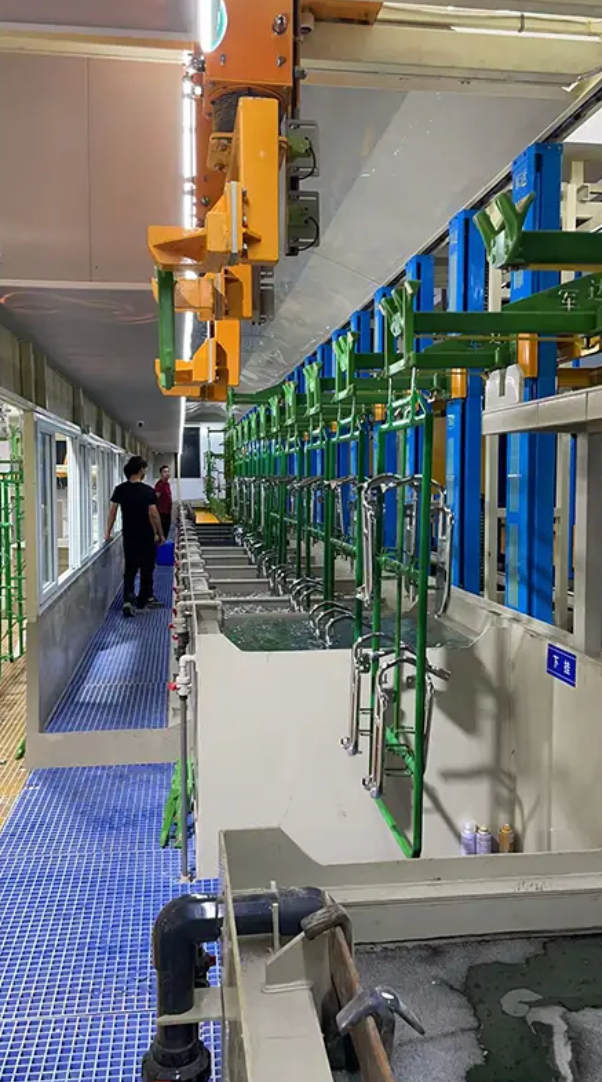
Awkward shapes throw off standard current distribution. A good line uses custom racking that tilts parts just enough to release trapped air from blind holes and deep recesses, while also letting solution drain instead of pooling. The angle isn't random; it's set based on the part's lowest point and highest current density area.
For deep concave areas like the inside of a fuel tank tunnel or between closely spaced fins, auxiliary anodes are placed close to the surface. These pull deposition into spots where the main anode's field can't reach. Operators often pair this with pulsed current so that the high-current edges don't burn while the valleys catch up.
Masking and robbers handle the opposite problem—areas that plate too fast. Sharp corners, threaded holes, or the edges of sprocket teeth get shielded or surrounded by sacrificial cathodes. The right line treats every odd shape as a current-flow puzzle rather than just dipping the part and hoping for even coverage.
Supplier Claims Worth Testing with a Small Batch First
Most suppliers sound confident on a call, but the real story shows up when you run a few hundred units through your own process. A small batch lets you check more than the spec sheet: how the material handles on your equipment, whether lead times hold up, and what kind of support you get when something drifts out of tolerance.
Rather than chasing every claim, pick the two or three that matter most for your production. If a supplier promises faster turnaround, send a modest order and track it day by day. If they claim better durability, put that batch through a shortened version of your stress testing. The goal is not to prove them wrong but to see how their promises survive contact with your actual workflow.
Keep notes on what you observe, especially the quiet details no one puts in a brochure: packaging quality, labeling accuracy, how quickly they answer clarification questions. Those small signals often predict what a full-scale relationship will feel like. A pilot order costs a little extra time now and can save you from a much larger inventory or production problem later.
The Maintenance Conversation Most Buyers Skip Until It's Too Late
Most buyers spend hours comparing upfront costs, features, and warranties, but almost no one asks what happens after the purchase. The maintenance conversation—how often it needs service, what parts wear out first, and whether a local technician can actually fix it—gets skipped because it feels like a problem for another day. Then the first unexpected repair lands, and that day is suddenly now.
A smarter approach is to ask the seller three questions before signing: What is the realistic service interval, what is the most common failure after two years, and what does a typical repair bill look like in this region? These questions feel awkward because they force the seller to admit weaknesses, but that discomfort is exactly why they matter. A product that can survive an honest maintenance conversation is usually one that will still be running long after the warranty expires.
Waiting until the first breakdown to think about upkeep turns a simple purchase into an expensive lesson. The buyers who avoid that trap are not the ones with mechanical expertise—they are the ones willing to have a slightly uncomfortable conversation before the sale closes. Five minutes of honest talk about grease, filters, and spare parts can save thousands of dollars and weeks of downtime later.
Why Local Support and Spare Part Lead Times Matter More Than Spec Sheets
A machine's brochure can list impressive throughput, precision, and energy efficiency, but those numbers mean little when the equipment sits idle waiting for a technician who is three time zones away. Local support teams understand regional operating conditions—dust, humidity, voltage fluctuations—and can often resolve issues on the first visit rather than cycling through remote diagnostics. That familiarity with the environment and common failure modes cuts downtime dramatically.
Spare part lead times are the hidden cost that no spec sheet reveals. If a critical component fails and the nearest replacement is six weeks out by sea freight, the theoretical productivity gains evaporate. Suppliers with regional warehouses or local distributors can deliver parts in days, not months, and they often keep stock of items that fail most often in your specific industry. This logistics advantage is often more valuable than a 5% higher rated speed.
Buyers who fixate on technical specifications frequently overlook the total cost of ownership. A machine with slightly lower specs but a responsive local dealer network will typically outperform a higher-spec model that leaves you stranded after the sale. When evaluating equipment, ask for references from nearby customers, check the physical location of spare parts inventory, and confirm average response times—not just theoretical ones.
A Field-Tested Way to Compare Vertical Lift Plating Quotes
Comparing quotes for vertical lift plating usually turns into a spreadsheet of line items that hide more than they reveal. The practical approach we've used in the field is to ignore the bottom-line number until you've checked three specific variables: the lifting height range, the platform load rating, and the power source consistency across each bid. These three factors account for most of the price spread between seemingly identical systems.
Start by normalizing every quote against a baseline of a 48-inch lift height and a 2,000-pound static load. Some suppliers quote a 42-inch travel but call it comparable, while others bump the motor horsepower without changing the cylinder bore. That mismatch alone can swing a quote by fifteen percent. Ask each vendor to fill in a one-page technical sheet that specifies cylinder diameter, rod size, and flow rate at maximum extension. You'll quickly see which quotes include oversized components you don't need and which ones cut corners on the frame gussets.
Finally, compare the warranty terms alongside the price by requesting the exact failure statistics for the limit switches and hydraulic seals under continuous-use conditions. A cheaper upfront quote often carries a 90-day seal exclusion, which means a $400 replacement job inside the first year. The field-tested method is to divide the total cost by the expected cycles before first major maintenance—that's the only number that matters when the lifts are running three shifts a day.
FAQ
Complex geometry parts like wheel hubs, brake calipers, handlebars, brackets, and small fasteners with deep recesses or blind holes gain the most. Vertical lift moves the whole flight bar up and down while rotating, which improves solution exchange and gas release. Barrel plating can cause parts to nest or bruise; rack systems often leave contact marks. Vertical lift holds parts in dedicated fixtures and moves the entire bar, reducing those defects.
Key items include hoist lifting capacity and speed, tank dimensions and solution volume, anode type and distribution, rectifier output with low ripple coefficient, temperature control accuracy, filtration turnover rate, and drying air uniformity. Also check whether the PLC and HMI support recipe storage and real-time monitoring. Don't just count the number of tanks; verify the dwell time and transfer time for each station against your target throughput.
Look at tank material: PP or PVC should be at least 10-12 mm thick with external steel reinforcement. Welds should be double-sided hot air or extrusion welded, not simple butt joints. The hoist frame and lifting arms need stainless steel or proper anti-corrosion coating. Copper busbars and conductive saddles require insulation protection. Also inspect anode baskets and membranes for easy maintenance, and confirm the presence of drip trays and spill containment curbs under each tank.
Ask to see the PLC program logic and actual running videos. A good system should automatically control hoist transfers, tank lowering/lifting speeds, dwell times, and current density curves. The HMI should display process parameters for each batch, alarm history, and maintenance reminders. Avoid quotes that only offer simple timers or manual push buttons. Also ask if the supplier will give you access to modify the program; many plants have been burned by locked code when they need to adjust process later.
There must be tank-side ventilation for chrome mist and acid fumes, including exhaust hoods, ductwork, and connection points for scrubbers. Splash guards, emergency eyewash stations, and safety showers are non-negotiable. Confirm floor coating and chemical-resistant sealing. Electrical cabinets should be located away from wet areas and have positive pressure or corrosion-resistant seals. Wastewater drains need separate pipes for chrome, cyanide, acid, and alkali streams. Open floor drains without segregation are a red flag.
Ask about response time and spare parts inventory location. Request a recommended spare parts list for three years, especially wear items like heaters, thermocouples, rectifier modules, hoist wheels, and lifting chains or wire ropes. Visit an existing installation of the same type and talk to the operator about downtime and repair history. If the supplier has no local service engineer or spare parts warehouse, a small fault can shut down the whole line for weeks.
They focus only on initial price and ignore energy consumption for heating and ventilation. Some quotes exclude rectifiers or hoists, leading to surprise add-ons later. Others shrink tank dimensions to lower cost, leaving insufficient immersion depth or anode-to-cathode spacing. Installation, commissioning, and training fees are often overlooked. Instead of comparing equipment prices alone, calculate hourly operating cost including electricity, water, and chemical consumption, plus estimated annual maintenance.
Adjustable flight bar spacing, modular rack design, and hoist variable frequency drives are essential. The plating tank should have multiple anode basket positions so you can change anode area quickly. The program must support fast recipe switching for different parts, with different lowering depths and dwell times. Also look for a spare or utility tank to handle multiple plating chemistries. If your product mix changes often, choose a structure that can later be upgraded to dual hoists or additional tank positions.
Conclusion
A reliable vertical lift plating line for motorcycle parts starts with the lift mechanism itself. Before production ramps up, watch how the carriage travels under full load, listen for hesitation or drift, and check whether guides stay aligned when baskets swing. Awkward shapes like fenders, swingarms, or triple clamps require more than standard racking—good suppliers show how anode placement and agitation adapt to each part, not just a catalog photo.
Any claim about plating speed, thickness uniformity, or chemical consumption deserves a small batch trial on your actual parts, not polished samples. Ask about maintenance access to chains, bearings, and rectifier cooling; if the seller avoids that conversation, lead times for spare contactors or guide rollers will hurt later. Local support often beats a fancy spec sheet. Finally, compare quotes by running the same test parts through each shortlisted line and measuring rejects, cycle time, and labor—not just the sticker price.
Contact Us
Contact Person: hayyr
Email: [email protected]
Tel/WhatsApp: 8613082110525
Website: https://www.jundaelectroplating.com