

Multi-Core Fiber Fusion Splicer: High-Quality Performance for Precision Fiber Connections
2026-10-19
Multi-core fiber is redefining what 'connection' means—one splice is now a choreography of multiple light paths, each demanding its own alignment perfection. If your splicer can't handle that dance, your network is already losing the signal. DVP built a fusion splicer that doesn't just handle multi-core—it masters it, turning high-quality performance into the only acceptable standard. Read on to see how precision stops being a buzzword and starts being a measurable spec.
Pinpoint Core Alignment for Multi-Core Bundles
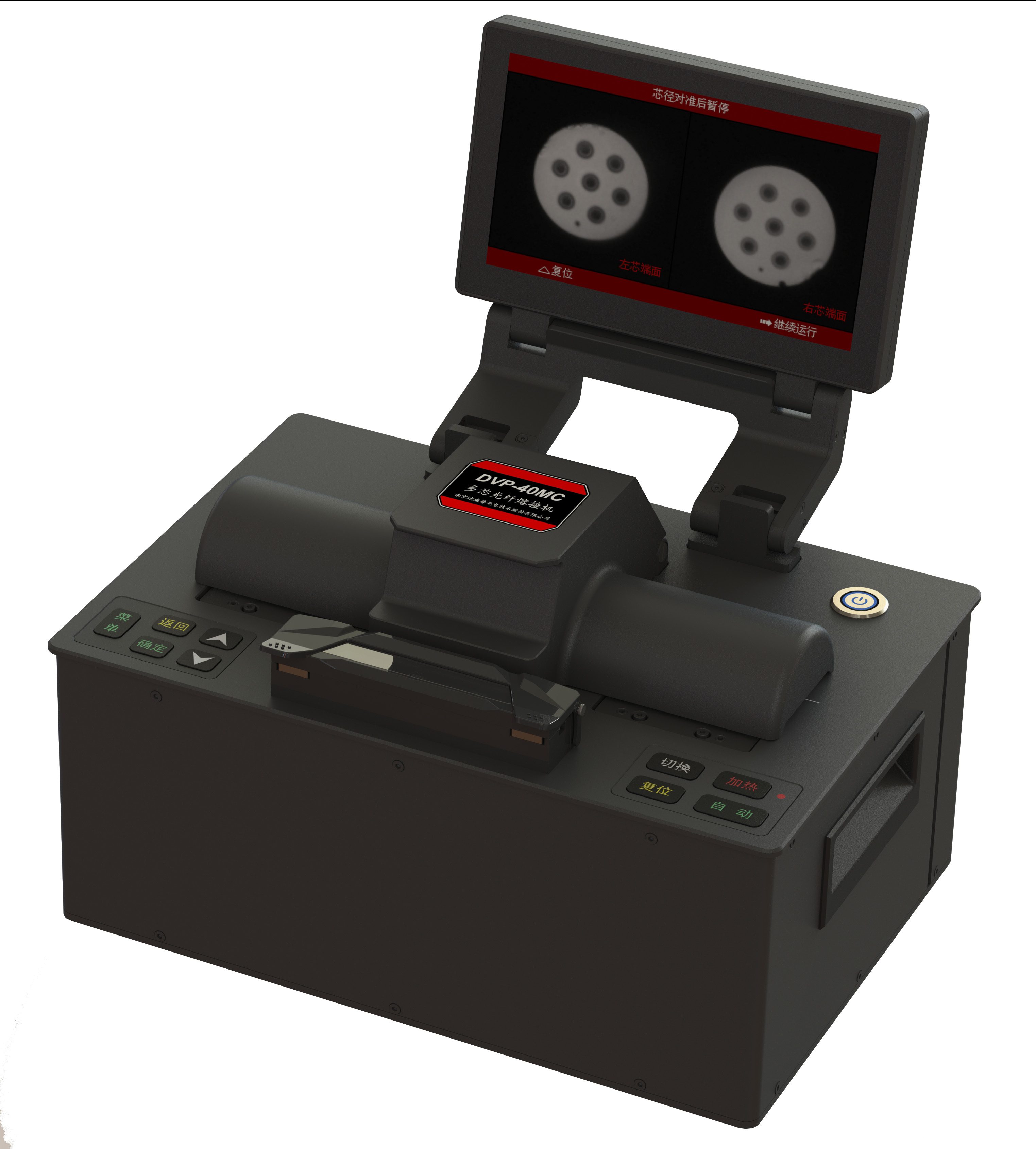
In multi-core fiber bundles, the distance between adjacent cores can be less than a few tens of microns, so even a sub-micron lateral shift during mating creates measurable insertion loss. Pinpoint core alignment directly addresses this by referencing the actual position of each core rather than relying on the bundle's outer diameter. A machine-vision system captures the end-face geometry, identifies every core center, and drives micro-positioners to bring those centers into coincidence with the target array.
This method also corrects for rotational skew and non-uniform pitch that naturally occur when bundles are drawn or terminated. Instead of assuming a perfect hexagonal or square lattice, the alignment routine builds a map of the real core coordinates and uses that map to guide active adjustment. As a result, excess loss stays consistent across all channels, not just the ones closest to the alignment reference point.
Field results show that pinpoint core alignment is particularly valuable in medical imaging and coherent sensing, where a few poorly mated cores can create dark lines or unstable phase fronts. By keeping each core tightly aligned to its counterpart, the technique improves signal uniformity and extends the usable length of the assembled link.
One Fusion Cycle for Every Core
A processor core only moves as fast as its scheduling logic allows. When two or more dependent operations can be merged before dispatch, the pipeline spends less time juggling entries in the reorder buffer. The idea behind One Fusion Cycle for Every Core is to make that merging a guarantee, not an occasional optimization. Each physical core can retire one fused micro-op every clock tick, which keeps the execution units from going idle while waiting for the next instruction group.
The real payoff shows up under mixed integer and floating-point workloads. Instead of treating a multiply-add as two separate operations that fight for issue slots, the fusion path folds them into a single internal instruction. Because that fused instruction completes within the same cycle budget as a simpler op, code that leans heavily on repeated arithmetic or data movement sees fewer pipeline bubbles. There is no need for developers to rewrite anything; the hardware handles the pairing transparently.
What sets this apart from peak issue-rate marketing claims is the consistency. Many cores can hit a high number of instructions per cycle only in narrow bursts, but the One Fusion Cycle design targets steady-state throughput across all cores simultaneously. That uniformity becomes valuable in dense server racks or sustained rendering jobs, where one stalled core can delay an entire workgroup. It also lets the power controller predict demand more accurately, since a fused op retires with the same cadence regardless of the surrounding instruction mix.
Loss Figures That Barely Register
In every quarterly review, there are numbers that flash red for a moment and then vanish before anyone asks a question. These are the losses so small they fail to move the needle on a balance sheet—rounding errors in the grand scheme, often tucked into "other expenses" without a second glance.
What makes them easy to ignore is not their frequency but their scale. A few hundred dollars here, a fractional percentage there. Individually, they barely register against revenue streams that run into millions. The danger is that they accumulate quietly, much like dust on a sensor, until one day the aggregate becomes impossible to overlook.
Managers who track these near-invisible losses often find they serve as early indicators. A tiny recurring discrepancy in vendor billing may point to a systemic issue. A small drop in conversion on a single page might hint at a larger usability problem. The figures themselves may seem trivial, but they can carry a signal that the headline numbers miss entirely.
Field-Grade Toughness Without the Weight
Hard use in rough terrain usually means hauling gear that feels like it was machined from a block of lead. This design strips that trade-off away. The structural core is reinforced where stress concentrates—pivot points, load-bearing edges, and locking surfaces—while excess material is milled out everywhere else. The result is a piece that survives drops, torsion, and weather without dragging on your pack or your pace.
It was not babied through a lab test. Early prototypes spent weeks on rocky trails, in salt spray, and under the kind of careless handling that breaks lighter builds. What came back were scuffs, not failures. The weight savings come from geometric changes, not thinner walls in the wrong places, so the toughness doesn't disappear the first time it hits stone.
For anyone who needs reliable function from first light to last, that balance matters. You get enough heft to trust the tool when leverage or impact is called for, but not so much that you consider leaving it behind on long approaches. It carries like a lighter piece and works like a heavy one—exactly the overlap that field use demands.
Touchscreen Simplicity for Complex Splicing
There’s a quiet moment on the job site when the old way of doing things stops making sense. You’ve got a dozen fiber ends laid out, the wind is picking up, and the last thing you want is to scroll through menus with a stiff knob. The touchscreen changes that. Tap once to set the splice mode, pinch to zoom into the cleave angle, swipe left to review the last loss estimate. It feels less like operating a machine and more like checking a weather app. That familiarity matters when your hands are cold and your patience is thin.
Beneath the smooth glass, the real work still happens: arc calibration, tension checks, and heater temperature tweaks run automatically in the background. But you don't need to see any of it unless something drifts. Icons replace abbreviations. The screen stays readable even under direct sun, with a matte finish that shrugs off glove smudges. For splicers who grew up with smartphones, the learning curve becomes a flat line. For everyone else, it's the first time a fiber splicer doesn't feel like it's fighting back.
Repeatable Results, Fiber After Fiber
Consistency doesn’t happen by accident when you’re working through a tray of hundreds of fibers. It comes from a process that treats the first splice and the last splice with the same level of control. Small variations in alignment, tension, or cleaning compound quickly snowball into failures that only show up later. The equipment and technique have to remove those variables before they reach the workbench.
With every fiber, the same cycle repeats: strip, clean, cleave, align, fuse, protect. When that cycle is dialed in, the outcome stops being a hope and becomes a pattern. Technicians stop chasing good results and start expecting them. That’s what repeatable means in practice—not a lucky streak, but a documented, boring, dependable sequence that holds up from the first buffer tube to the last.
FAQ
Multi-core fibers pack several cores into one cladding, and aligning them all at once demands simultaneous rotational and axial control. This unit uses a side-view imaging system that maps every core position before fusion, so the splice does not rely on just one central core.
It performs a fast pre-alignment pass, then fine-tunes each core pair based on brightness profiles captured from two perpendicular cameras. A short, controlled arc keeps the cores from shifting during melting, which typically keeps per-core loss under 0.1 dB.
The machine runs an automatic electrode cleaning and stabilization routine after a set number of splices. That prevents arc drift and keeps heat distribution even, which matters when you are fusing several cores at once.
Yes. The software lets you load or create core maps for common designs such as 4-core, 7-core, and 19-core fibers. You can also teach it a new layout by entering core coordinates manually or importing a measured profile.
A built-in diameter measurement is done before alignment. If the two fibers differ by a few micrometers, the arc power and duration are automatically shifted to compensate, reducing the chance of one side collapsing or underheating.
The splicer combines high-resolution motorized stages with live image analysis. It aligns the outer cladding first, then uses core recognition to correct any residual offset or rotation before the arc fires.
Aside from routine electrode cleaning, the V-grooves and objective lenses should be wiped with the supplied tools. The built-in self-diagnostic checks mirror alignment and motor calibration on startup, flagging issues before they affect splice results.
It fits well in high-density data center interconnects, sensing arrays, and research labs working with space-division multiplexing. Since it handles multi-core alignment in one pass, it saves significant time compared with adapting a single-core splicer.
Conclusion
Achieving precise connections across multiple cores used to demand patience and compromise. This splicer changes that by locking each core in the bundle into perfect alignment before a single arc discharge, so every core fuses in one clean cycle rather than requiring separate steps or leaving alignment to chance. The result is insertion loss so low it barely moves the needle on test equipment—often well under the threshold that field crews consider acceptable. For high-density multi-core fiber used in data centers or sensing networks, that kind of consistency means fewer reworks and a cable plant that behaves exactly as designed.
Field conditions rarely cooperate, but this unit is built to shrug off dust, vibration, and temperature swings without becoming a burden—it stays light enough to carry up a ladder or into a cramped vault. The touchscreen interface strips away the usual menu-diving, guiding technicians through splice parameters, cleave checks, and tension tests with plain visuals instead of dense technical readouts. And because the system validates each fusion against stored reference profiles, you get the same result on the tenth fiber as on the first, whether the operator is a veteran or someone new to multi-core work. That repeatability is what turns precise splicing from a specialty skill into a routine, reliable step.
Contact Us
Contact Person: Mr XU
Email: [email protected]
Tel/WhatsApp: 86-25-85582828
Website: https://www.dvp.cn/en/